Monday, November 22, 2010

Venice is Sinking, So What?

Take a naturally protected lagoon averaging approximately 6 feet in depth, pound sturdy posts in concentric circles 30 or so feet into the sand bar, pile upon it large stones for a solid foundation, then construct a beautiful ornate building.  Do this thousands of times linking everything together with  countless bridges to walk between them.  Then dominate Europe for 400 years or so, accumulating the wealth you have “borrowed” in order to decorate your city built on sand, and what do you get………Venice!

DSC02230

   DSC02095 DSC02068

Yes, it’s sinking; yes, it’s expensive; yes, it’s overcrowded with tourists; yes, it’s old and decaying and past it’s prime…..so what?!?  The magic, beauty and uniqueness trumps all of the reasons not to go.

DSC01973 DSC01725

DSC01884

Before we relinquished our good friend, Francois, (our rented Renault), we thought….why not.  Italy wasn’t originally on our itinerary, due to it being very expensive, but we got creative and figured out a way how not to spend our remaining budget in 4 nights   We made our way to Venice!

DSC01900DSC01737 DSC02067DSC02140

We’ve visited many picturesque places on our trip and Venice was no exception.  Our shutter didn’t get any rest.  We snapped picture after picture as every turn of our strolls through the city revealed another…”That’s so cool” moment.

 DSC01802 DSC01837

 DSC01929 DSC01940

We water taxied and walked our way through the city for 4 days loving every minute of it.  We saw the touristy stuff, but we also got off that beaten path and headed into the sections of town where real Venetians go to the market, the kids go to school and, most importantly, tourists don’t go – yes people actually still live there.

 DSC01903 DSC02102  

Las Vegas and The Venetian Hotel, with it’s artificial canals and San Marcos Square look-alike, can’t capture the finely aged ambience of one of the great cities in Europe. 

DSC02142DSC02249

Go to Venice if you have a chance and get lost in its streets and charm.  It may not be with us forever. 

DSC01995  DSC01752

DSC02055 DSC01836

DSC01872

Saturday, November 20, 2010

Believe it or Not: Belgrade

Our nerves were a bit on edge heading into the bully of the Balkans.  After witnessing the damage of war in Bosnia & Herzegovina, inflicted mainly by Serbs, we were a little raw.  It was hard to know what to expect in a country that was the former Yugoslavia’s political and power capital.  Not only had Serbia fought and lost to all of it’s neighbors, but they are currently struggling and failing to hold on to it’s latest foe, Kosovo.


Belgrade is trying hard to help tourists understand and enjoy their experience.  We found a delightful organization, Belgrade Hosts.  Their volunteers personally meet visitors and spend time answering questions, making recommendations and sharing historical important sights and information.  Our host was a smart, energetic young woman.  She is studying international economics and has no interest in traveling to the US.  We found it curious to learn that Russia is where she wants to spend more time.  In fact, we found that Belgrade as a whole seemed to be aligned with Russia far more then the western world.  She led us on a great walking tour of the old part of Belgrade, but we really wanted to hear her views on the current strife between Serbia and Kosovo.  We were disappointed when she gave a politically correct answer and changed the subject.  In fact, everyone we asked about the Kosovo situation wouldn’t engage.  We weren’t sure if it was because we are Americans or because it was a highly personal topic. 

We had no idea that Belgrade has been at war for nearly 2,000 years with only a few short periods of peace.  It is beautifully located at the confluence of the Danube and Sava rivers on a natural limestone hill amongst an otherwise flat area.   The position made it very obvious for the city’s location and attractive to invading enemies.  It has been raided and rebuilt dozens of times.

 DSC01265   DSC01297

The architecture showed all the influences of the various powers.  Very modern building, ornate Viennese decoration from the former Hapsburg times, bulky communist era buildings, and war damaged structures all exist together.  Quite a site.  A work in progress you might say. 

DSC01242    DSC01369  DSC01344  DSC01200

   DSC01382DSC01341

One of our most stressful times so far happened in Belgrade.  And it didn’t have to do with their use of nor our struggle with the Cyrillic alphabet.

DSC01348DSC01368

It’s not a typical goal for us, but in Belgrade, we decided to find the US Embassy.  We were curious because we’d read that it was attacked in 2008 over the Kosovo issue and in a few days, Secretary of State Clinton was visiting.  We walked through the city until we found the US Flag flying on a building.  Seeing the stars and stripes made our pride inch up.  We hadn’t seen it in a few months and it looked good.  As we got closer though, our moods slowly dampened.  We noticed that all of the windows facing the street were covered.  There were gigantic cement planters in front in which the plants and flowers did nothing to take away the real purpose of these garden barricades.  It was a sobering sight.  It was a business day but it looked shut up as if awaiting a not so pleasant situation. 

Being the tourists that we are, we started snapping pictures when all of a sudden, three extra large Serbian guards from across the street started yelling.  We were pretty sure they were hollering at us, but we ignored them.  Then they screamed at some people near us to stop us.  After the 3rd forceful shout directed at us, we thought we’d better go find out what they wanted.  We explained that we are US citizens and just wanted a few pics of our embassy.  They demanded that we delete the photos and pointed to a tiny sign, behind a leafy tree, that indicated no pictures were allowed.  When we rolled our eyes, they said these are “your” rules not ours, and that if we didn’t delete, we could all go “visit” the police for questioning.  We were scheduled for a tour of the Nikola Tesla museum so we consented and deleted the pictures. 

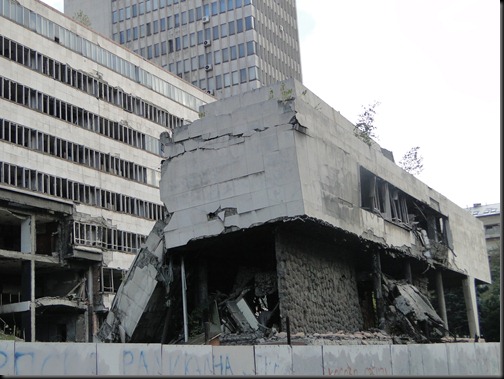
After walking a few blocks, trying to shake off our brush with Serbian men in uniforms,  we found and photographed several destroyed buildings that NATO forces had bombed in 1999.  If it wasn’t for a few weeds growing out of the ruins, you would guess that the bombings took place only yesterday.  Keep in mind that these buildings are in the business and political heart of Belgrade.  Prime real estate.  Why have they left the shell of former large military offices unchanged for 11 years?  A reminder to the working stiffs to hate NATO?  We can only guess but it seemed like some sort of statement was being made. 

Between the encounter with the huge Serbian guards and seeing the striking war damaged buildings made for a very intense afternoon. 

DSC01302  DSC01304

On a positive note, the Nikola Tesla Museum was lots of fun.  It was the perfect distraction from the earlier events of our day.  Nikola Tesla is the inventor of alternating current and single handedly changed the way the world is powered.  He helped George Westinghouse create and store hydro electricity created by Niagra Falls.  You might remember him from a role in The Illusionist, a decent movie about a couple of magicians.  We had seen the movie so it was really enjoyable to know more about the man behind the character.  He is the real magician!

DSC01325DSC01330

Visiting Belgrade, Serbia was a last minute decision.  We’re glad we went, but we don’t want to go back.  We wanted to experience a little of the country that we’d heard so much about from Croatians and Bosnians.  We know that with any story, there are two sides, and we wanted to get the Serbians perspectives.  Unfortunately no one would discuss the 1990’s war or the current situation with Kosovo.  When a powerhouse goes down, it probably uses the best coping strategy around; denial.  Could it be that the U.S. is using this same strategy?  

Sunday, November 14, 2010

Eye Opening

DSC00932  DSC00953DSC00961DSC00914

The really high hill out our hotel window was the answer to our prayers.  We needed some exercise.  Some real exertion.  Our hearts were asking to be pumped faster, our skin wanted to feel sweat, and our souls needed nature.  We were in Mostar, Bosnia & Herzegovina, our first time in country that is primarily Muslim.  And the first time to hear the wailing, brooding call to prayer.  Curiously, the hill we were planning to climb had a huge cross on top of it.  A cross?  In a mostly Muslim country?  Oh well, we didn’t care what was on top, we were going to climb it.  Initially we wanted to just wing it and find the way to the top on our own, but at the last minute we decided it would be better to ask for some directions.  The receptionist said, “you want to do what?  You can’t climb that hill.  It’s full of landmines and is extremely dangerous.”   Our mouths fell open. 

We knew that Mostar was a battleground in the recent 1991-1995 war, but who would’ve guessed that unexploded landmines were still in the ground 15 years later.  Seeing all the bullet riddled homes, bombed out buildings, and hearing that our hill was still extremely unsafe completely shifted our mood from surf and sun to war and peace.

DSC00974DSC00907

  DSC00911DSC01089

The Balkans war or, more accurately, the breakup of the former Yugoslavia, was a bloody ugly mess.  Scars from this conflict are still very much present in many of the cities and towns we visited. 

We watched video footage in Mostar’s City Museum on how the Croatian Army was able to blowup it’s beloved bridge, Stari Most.  The bridge was built by the Turks 500 years ago connecting two communities, each believing differently in the way to heaven.  To the Bosnians it has long been the symbol that Muslims, Jews and Christians could live peacefully as neighbors.  It was rebuilt in 2004 and is beautiful architecturally but is more important for it’s symbolism.  To this day, they are proud of their religious tolerance.  Which, we commend.  Many of the Orthodox Christians and Jews that left during the war are slowly finding their way home again.

  DSC00997       DSC00978  


DSC01152


It was really sad to see Sarajevo, the sight of the 1984 Winter Olympic games, still rebuilding after a crippling war.  The lush valley it’s in, made it vulnerable to attack and the Serbs took advantage.  During the four year siege of Sarajevo, their forces rained an average of 300 plus bombs a day onto the city.  Serbia didn’t want to loose another piece of what it thought was it’s territory.  The bobsled run used for the Olympics has all but been destroyed.  The stadium that was used for the festive opening and closing ceremonies was used to collect dead bodies and is now surrounded by cemeteries.  Parks and High School soccer fields were converted to graveyards.  Every one of the tombstones indicating the year of death as 1993 or 1994.

DSC01046 DSC01050

We toured “sniper alley” where the Serb forces stationed on the hills of the area, randomly killed civilians daily.  We saw the city’s fabulous library under a shroud of scaffolding.  It’s being rebuilt after it and thousands of priceless, irreplaceble books were systematically destroyed.  (Sarajevans risked their lives to save as many books as they could.)  We visited a tunnel that was the only means by which the city was able to get fresh food, medicine and weapons to protect itself.  Without the tunnel (and a massive bombing by NATO on the Serbs that surrounded Sarajevo) this former Olympic host would’ve fallen to it’s opponent.  We think it’s a good thing it didn’t. 

DSC01170DSC01123

DSC01157DSC01149

Being temporary locals in the cities of B&H was eye opening.  Seeing the result of the multiyear siege and the damage caused by the bullets and mortar made us uncomfortable.  Learning from a few of it’s people that they never questioned that they would stay and fight for their city; made us wonder, would we put our lives on the line for our city, our country, for religious freedom? 

On a positive note….the coffee was really really really good….Bosnian Coffee, our new favorite….until Turkish Coffee!

DSC01187

Wednesday, November 10, 2010

Strange Things

Admittedly, we’re having trouble being creative with our blog posts.  We’re behind by about a month and can’t find the energy it takes to write them.  We’re having such a great time experiencing and seeing so much.  At times it’s hard to express our perspectives.  This one isn’t hard to share. 

Someone recently asked me, what’s the strangest thing we’ve seen so far, so for this post, we thought we’d answer that question.  3 very strange things immediately come to mind and as you might imagine they all have to do with food….

On a menu at a up scale restaurant in Arequipa, Peru– Deep Fried Cow Teet.  Although tempting, we didn’t try it.

On a menu in a neighborhood restaurant with mostly local patrons (very few tourists) in Antalya, Turkey – Sacrificed Animal Meat.  Other wise known as whole chicken.   We tried it and it was gud.

We saw this impulse item in a corner market in a small town in Peru.  We had to buy it.  Steve wanted to taste the goodness but Amy stopped him from giving in to his curiosity.       DSC02491  Strange stuff makes for a very interesting world!