Sunday, July 11, 2010

WOWSA - The Galapagos

Our expectations were exceeded, to say the least.  The amount of wildlife in The Galapagos Islands that we saw, up close, was amazing.  Our reaction to the islands is of awe.  We are so very happy that a place on earth still exists where the animals are not afraid of humans and humankind does very little to interfere in their lives.  (Although we understand that just being there interferes.  It´s a balance we are grappling with - how to enjoy nature without spoiling it in the process.)  We witnessed birth, death, injuries, playfulness, mating, fighting, every activity imaginable.  The odors, sounds, behaviors, colors are indescribable.  The only way we know how is to post pictures.
We have broken up our pictures into 3 postings - above water wildlife, below water wildlife and the flora and scenic vistas.  First up, of course, Blue Footed Boobies.  The Galapagos wouldn´t be the Galapagos without all the Boobies.  We were lucky enough to see and hear their courtship behavior.  The males prance around proudly showing off their blue feet one at a time.  The bluer the feet the better the babies - it all has to do with blood flow.  The female gets to choose and either shows interest or acts completely indifferent.  We watched multiple males competing for a single female doing their dance.  Their whistling, and her honking could´ve kept us entertained for hours.
Notice the difference in pupil size, they are very distinct.  The female has the larger pupils.  All the better to see those blue feet.


Next...the Galagagos Turtle...such a sad story of pirates and others killing 10s of thousands of them for food. Then introduced goats eating all of their food and shelter.  They are struggling to survive.  We got to see these giants up close and personal.  Our naturalist fed passion fruit to one of these big males, and he litterally came within two feet us!  Amy had to move out of the way in another instance when one of these guys decided to walk right where she was standing.  She could have reached out and touched him, but of course didn´t.

We feel in love with the Land Iguanas...
and the Marine Iguanas....  Many times we literally had to step around these guys as they are everywhere!

Marine iguanas warm themselves in the sun on the rocks and by cuddling with each other.

They eat algae under the water while cligging to the rocks and coral in some very fast currents and then swim back to shore propelling themselves with their massive tail.

We watched as several Short eared owls hunted Galapagos storm petrels, during the day,
for an unsuspecting tasty meal.
Is it a bird or a fish?  It was a flying bird at one time in it´s evolution, now it´s a Flightless cormorant.  They have the most pathetic wings we´ve ever seen on a bird.
 
Be sure and notice the Flightless cormorant´s turquoise eye.
Galapagos Greater Flamingos....so beautiful and so endangered.
A Swallow-tailed Gull Family.  Notice the red eye ring.


Red Footed Boobies....

 
We watched many varieties of Hermit crabs checking out their buddies homes (the shells on their backs).  They frequently upgrade to bigger and better homes and are always on the look out for the best fit.  (Sounds vaguely similar to The American Way.)  The Sally Lightfoot crab stole the show though....

Magnificent and Great Frigate Birds....and their babies...

When the males are trying to attract a female, they inflate their large red balloon-like sacks.  It is amazing to see these horny birds at work!  The females will see this brillant red sack from the ground....the bigger and redder, the better.  Than she will fly down to see if it is as big as advertised.  She gets to make the choice to stay and allow him to mate if she likes what she sees, or move on to the next willing fellow.

The florescent green feathers on the Frigate´s back are much more distinctive in person.
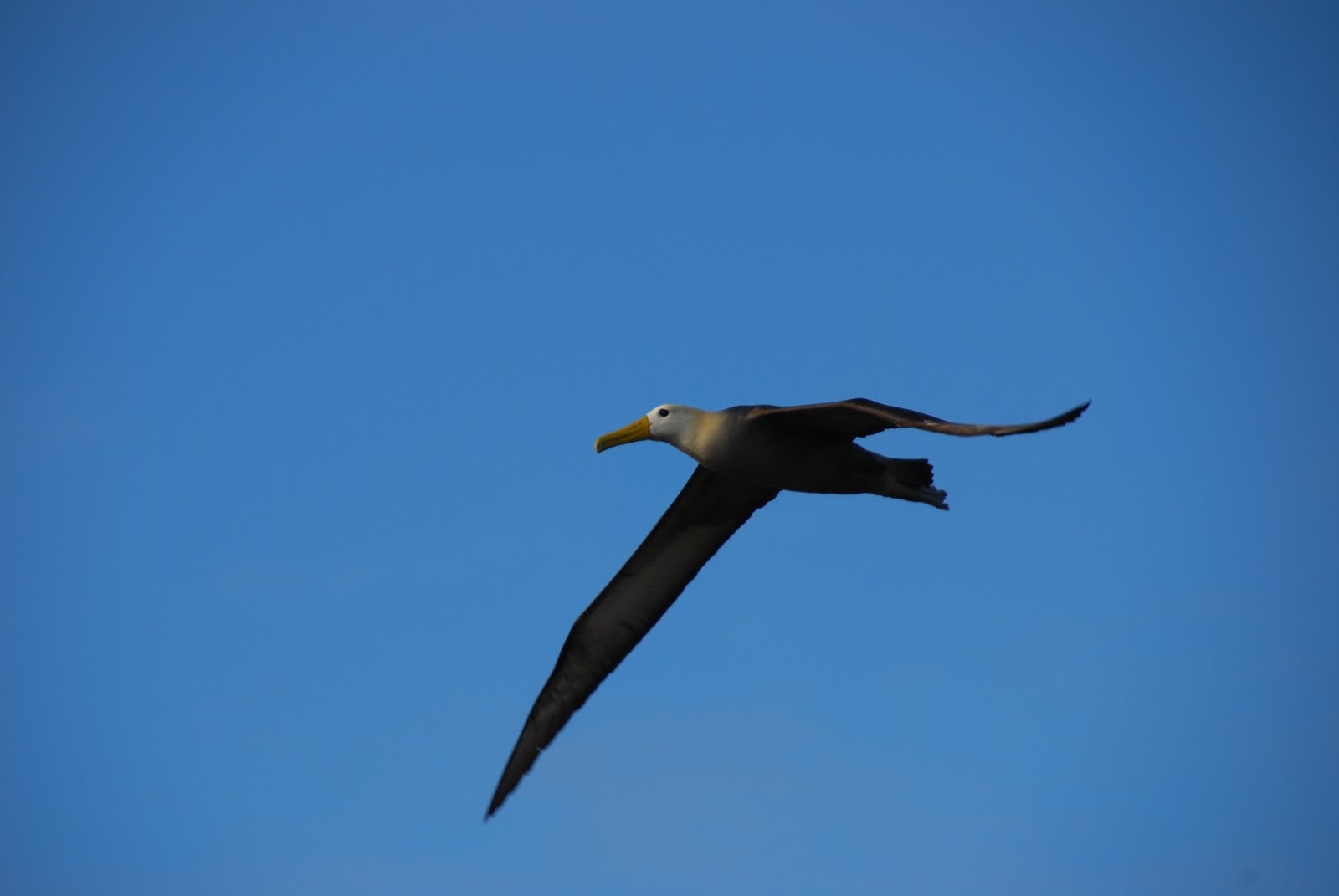
The Waved Albatross is another special creature.  These birds are only found on one island in the Galapagos and no where else in the world.  They have a 10 foot wing span and are as awkward on land as they are graceful in the sky.  Watching these large birds as they clumisly take off is another unforgettable moment.  We watched their bonding ritual and adored their antics.  The clucking, wobbling and beak clashing was spectular.


We´ve all seen Brown Pelicans and there are quite a few in The Galapagos.  The thing that makes them different is that they seem to enjoy that the Brown Noddies land on their head and wait for bits of fish to fall out of their mouth and into the water.  It was a hilarious sight.
The Red-billed Tropicbird was by far the most beautiful with it´s elegant flight and long graceful tail.  With our camera, a super-zoom but not an SLR, shooting birds in flight proved to be challenging.  So you have to look hard to really see these Tropicbirds.


Galapagos mockingbirds....there are four individual species, again all evolved from a single specie.
Nazca boobies...
Momma feeding her baby....
Last but not least are Darwin´s Finches.  There are 13 species in The Galapagos, all evolving from one individual specie.  We saw 10 of the 13.  Unless side by side we found them hard to tell apart and they are extremely hard to photograph.


For our birding buddies, for the record, we enjoyed many more birds then the above:  Audubon´s shearwater, dark-rumped petrel, Lava Gull, Great blue heron, Cattle egret, Lava heron, Striated heron, Yellow-crowned night heron, American Oystercatcher, Ruddy turnstone, Galapagos hawk, Galapagos dove, Smooth-billed Ani, Yellow warbler, White-checked pintail ducks, and Flying fish (not actually a bird, but their flock, I mean school, fooled us a time or two).  Stay tuned for our below the water friends. 

Tuesday, July 6, 2010

Perú - Passionate People, Pollution and Parasites

Many travelers have fabulous experiences in Perú.  And many parts of our experience there were wonderful too.  For this post we are compelled to write about the not so wonderful side of our adventures in Perú.

We were very happy to leave Perú.  Although we only saw a fraction of the entire country our impression was not a good one and we’re not anxious to return.  It would be impossible to revisit every area that’s on our itinerary, so fortunately we’ve found a few such a places they all just happen to be in the same country.  To us, Arequipa, Cusco, Aguas Calientes and the portion of the Inca Trail we hiked seemed very polluted and inexcusably dirty.
Look closely at this picture.  It is of a guy urinating in a very public place. In Cusco, we saw this happening over and over again and smelled it just as frequently.


Grand volcanoes surround Arequipa.  Unfortunately during the four days we were there they were shrouded in a layer of smog.  It reminded us of Los Angeles in the 1970s.


Perú is relatively poor, we realize, but we think that a high poverty rate is not an excuse for it’s population to throw garbage in the streets and rivers.  The views from the Inca Trial were stunning but the condition of the streams in this area of the high Andes is pathetic.

500 people hike the trail every day and there are only a few filthy bathrooms, so instead of using the bathrooms the trekkers and porters are “doing their business”  on or near the trail.  500 people a day!  This happens every day of the year, except for 30 days when they close the trail for maintenance.  Let’s see; 500 people x 335 days is 167,500 people a year relieving themselves somewhere along the trail.  All of the dishes and pots and pans are washed in the nearby streams.  And drinking water for everyone is collected from the streams near where 500 people a day are relieving themselves.  We thought it was absolutely dreadful.  More litter than you’d think was scattered along the trail as well.  Given the passion the Andes people have for their Inca history and all their spirituality towards mother earth, Pachamama, it was really depressing to us.
Below is a rock representation of Pachamama at a museum dedicated to her.
Passionate Peruvian people:


It seems that the politicians (the government controls the trail) should stop putting money in their own pocket, give a few people a job to regularly clean the bathrooms and as a result have healthier rivers and streams.  The 700 year old Inca bathroom below is not much better than the 'modern' versions along the trail.
We highly recommend Machu Picchu and the other Inca ruins, but not the Classic Inca Trail.  Find another way to the spectacular Machu Picchu.

By this time of our trip, we’ve both learned to say both “no gracias” or “solo estoy mirando (I’m only looking) over and over throughout the day.  Or, better yet, to ignore street vendors completely.  In Cusco the pushy vendors crossed the  proverbial line of harassment.  It was amazing how aggressive they were.  Amy sprained her ankle while quickly dodging a vendor when one stepped in her immediate path about 6 inches in front of her.  We were offered massages no less than 30 times per day.  The aggressiveness was nothing we’ve seen so far and we hope it is the worst.  We did succumb to a couple of really cute kids.  They were selling hand puppets, spoke perfect English and recited the past 6 presidents of the US.  We were impressed.  A soft hearted moment.  We now are proud owners of a llama, a vicuña, and an Andean condor.

We were warned - don’t trust the water in Perú.  Friends and strangers told us to be very careful.  For example, in Cusco we were told to boil our water for a minimum of 20 minutes before using it for cooking.  And we heard story after story of fellow travelers getting very sick.  So, we drank bottled water, didn’t eat fresh fruit or vegetables, and we didn’t eat any food from street vendors.  We were extremely diligent.  Or so we thought.  Our worst nightmare came true.  We got terribly sick.  The timing couldn’t have been worse.  We become violently sick to our stomachs after the first day of our 26 mile Inca Trail trek.  For the remainder of our trek, we forced ourselves to eat and drink.  All of our energy was in our guts and there was very little left for our legs, but we prevailed.  Machu Picchu was waiting.  Luckily our major muscles kicked in to high gear and powered through to the bitter end.  The terrain was steep.  Up was hard, focusing on the steep descent was harder.  We made it.  Barely.  And then we collapsed.
On the left is Amy on her worst day trekking.  It was the day we had to go over two mountain passes, one at nearly 14,000 feet.  She did not think she would make it.


Her hero is on the right, our guide, Raul.  He carried her pack and encouraged her the entire day - un poco a poco - little by little.  When appropriate he sang for her, waited for her and felt sorry for her.  He was the reason she made it all the way.  Oh, and the fact that all transportation was on strike during the time she would've turned around and given up.  

Poor Steve felt so terrible that he slept on a bench while we waited for an earlier train to get us to our next hotel.  Luckily Amy was able to hold it together enough to make the arrangements.  We only had to wait a mere 5 hours which seemed like an eternity.  It was the first time that we longed for our bed in the worst way.


We made it to our next hotel and slept for 2 days.  The strange symptoms persisted and we started to worry about our health and decided to seek expert advice; in Ollaytantambo, a high Andes town of 2000 people.  We went to the local clinic and talked to a doctor that fortunately knew a few English words.  For a measly 13 dollars we were told we had Giardia lamblia, a parasite in the intestinal tract that can be found in the water and on animals.   He advised us on the medicine to take and after just one pill we both felt 10000% better and we were able to eat and drink again without gagging.
Was it something we cooked prior to starting our trek????
As an example of the water situation, many Peruvian people, especially those that live in the Andes, never have a solid stool.  It is what keeps their life expectancy relatively low.  It seems like a rectifiable situation.  We have a hard time understanding why water purification isn’t more of a priority.  It’s probably a highly complex, bureaucratic situation but it’s water.  Isn’t water the source of all life?  Come on Perú - help your local people and your tourists be as healthy as possible - give ’em clean water!  Until then, we'll think twice before returning.